How to Paint a Car
By Shenron on Sep 02, 2007 with Comments 0
Painting your car will definitely improve its appearance and for some it is an easier process than you might think. While it does take skill, meaning that you must be patient and extremely precise, those that find they have these qualities will usually have no problem whatsoever painting a vehicle.
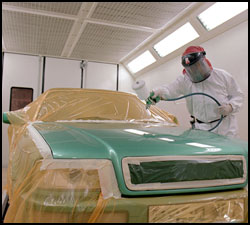
Here are some tips.
First off, you will need the following materials:
- Masking Tape
- Cloth or tarp to cover the vehicle
- One piece of wire
- Car washing detergent and brush
- Wax/Grease remover
- Sandpaper several grits both thick and thin
- Primer (amount depending on the vehicle size and the area size that will be painted)
- Paint urethane-based (amount depending on the vehicle size and the area size that will be painted)
- Paint Sprayer (if you choose, you can just use regular spray paint)
- Dust mask, goggles, clothing to cover your exposed skin
- Body putty and knife to apply it
1. Wash Your Car
Before painting your car it is very important to wash it thoroughly. Your car, even though it looks clean has lots of dust and grime on it that needs to be removed. Use normal car washing detergent. Once you wash your car with soap and water, use a wax/grease remover. You need to remove dirt that isn’t necessarily water soluble.
2. Sand the Area to be Painted
Every car has dips and rough spots that should be sanded down using various grits of sand paper. The smoother your car is, ultimately the better the paint job will be. For tough jobs, you might want remove a large piece and sandblast it, for normal or small jobs, sand paper should do the trick. If you notice any damage to the exterior, it is important to repair it before you apply primer or paint. This includes small dips, holes, etc. Use body putty and a putty knife to fix any holes, after which you should obviously sand and smooth out.
3. Prep Your Car for Painting
Once your car is completely dry and repairs are fixed including dips, you should prep your car for priming and painting. There are a few things you should do including covering up any areas which you do not want paint on. Use masking tape for edges and to tape cloth or a tarp over the windows, mirrors, chrome, etc. A good idea is to paint your car indoors, however make sure that you have proper ventilation in the area. Painting a car indoors keeps insects, dust and moisture away from your vehicle. It is also a good idea to stop static electricity attracting dust to your vehicle. Many people tie a wire from the chassis frame to a grounded object nearby.
4. Apply Primer to the Vehicle
After your car is fully prepped, you can start applying primer. Primer is applied to any surface which will later be painted with color. Primer will make the paint adhere to the surface of the vehicle better, giving you a professional looking paint job. When spraying primer, make sure the area is ventilated well, goggles and a dust mask offers good protection from the primer and paint.
Apply primer evenly on any surface area that will be later painted. Once the primer fully dries (about 90 minutes) you will want to sand the entire area down with fine sand paper. Just like paint, primer needs to be spread onto the vehicle evenly. Any dips or rises in the primer can detract from your paint job.
5. Paint Your Vehicle
Once the primer is dry and smooth you can go ahead and paint the vehicle. Use a urethane based paint for best results. If you are serious about your paint job, use a spray gun tool, if you don’t want to buy one, you can usually rent one from tool shops. Once ready, spray on the base coat of color. Take your time and spray evenly trying to make sure that the coat goes on smoothly and consistently. Once the base coat is fully on the vehicle, wait about 15 minutes for it to dry.
Now that the base coat is dry, spray a second coat of color onto the vehicle. Usually two coats of colored paint is good, however you can have up to 20 coats of paint (like some show cars). Between each coat of paint, wait at least 15 minutes for the paint to dry. On your last color coat of paint, wait 90 minutes for your coat of paint to dry before applying a clear coat.
6. Apply Clear Coat to the Car
Before applying clear coat to the vehicle, make sure your color coat has dried for at least 90 minutes. You will apply at least three coats of clear color onto the vehicle, waiting about 15 minutes between each clear coat. Once your have applied all three clear coats, let the vehicle dry for 90 minutes.
Your paint job should be complete.
If you would like to learn how to paint a car, visit iknewit.org.
Filed Under: General
