A Look Into the Features of A Formula One Racecar
By Shenron on Nov 26, 2007 with Comments 3
Formula One is considerably the most popular motor sport in the world. Majority of its event guidelines and regulations pertain to the construction and design features of its racecars. The cars must be designed in such a way that speed would be fully maximized as it makes it way onto the race track without compromising the safety of its driver. Failure to comply may result to elimination, thus making F1 racing also quite popular for its strict guidelines and procedures.
Aerodynamic design plays a key role in generating maximum speed and fuel efficiency for these racecars. Racecar aerodynamic designs are similar to that of jet fighters. However, unlike the latter, F1 racecars must be able to create down-force. Down-force is used to keep tires on-track during high-speed racing and most especially, when approaching corners. Aside from that, down-force also enables a better airflow around the car, which effectively eliminates drags, which can lessen speed and fuel efficiency. Modern-day F1 race cars are now equipped with aerodynamic down-force to ensure maximum efficiency which can even test limits and racing boundaries.
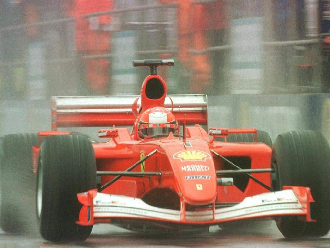
The part of an F1 racecar that houses the cockpit and is utilized as the central part of the chassis is called the monocoque. It is also onto the monocoque wherein the car’s engine and front suspension are mounted, in effect making it as an important part of the racecar. To keep it protected, most of the monocoque is built through the use of carbon fiber. To ensure additional safety conditions, the cockpit is also enforced with its own safety features.
Due to its racing conditions, Formula One racecars must have powerful yet lightweight engines.
Under FIA regulations, engines must be able to endure more than one race weekend. Consequently, engines must both be made durable and high-performing since engine failure is the main cause for early race termination in F1 racing.
Aside from the engine, the suspension system of the F1 racecar is also vital. Usual passenger vehicles derive comfort from suspension but in F1 racecars, the driver’s comfort is the least concern. The suspension systems in F1 racecars are designed to effectively combine aerodynamic down-force, engine power, and tire grip. These suspension systems are adjusted manually to be able to meet the specific needs of different race circuits.
Transmission is also looked into upon designing Formula One racecars. In contrast to usual passenger vehicles, F1 racecars are all made with just manual transmission. Though modern-day transmissions are highly automated and easier to manipulate, they still remain manual, which the driver had to adjust from time to time depending on his own racing conditions.

Since racecars speed off at such top-notch acceleration, effective means of slowing these cars down are also of utmost consideration. F1 racecars are equipped with disc brakes, which is quite similar to that of streetcars. However, F1 vehicles have brake discs composed of carbon fiber to help decrease weight while maximizing durability during increased temperatures. These brakes are used alongside specially compounded brake pads, which have been proven effective during extremely high-temperature conditions.
Last, but certainly not the least to be considered, are racecar tires. Only one company has been approved by F1 as its official tire distributor in the year 2007. In Formula One, racecar tires are made up of a special high nitrogen mixture of air to maintain tire uniformity and durable tire pressure.
Filed Under: General

[…] A Look Into the Features of A Formula One Racecar […]
i wanna know about the aerodynamaic structure of the caring cars . as im interested in cara . i have to do a presentation on the same topic .
thanks
There is plenty of info on those around the site, just search for “aerodynamics” and you should get a lot of results.